A Practitioner Field Report · Not a Demo

Human Out
of the Loop

Ten agents ran an autonomous fleet unattended for ten weeks: they ratified their own constitution, exchanged 18,404 messages, crashed in ways worth studying — and earned nothing. Study the governance rules, communication buses, and failure records from ten weeks of running a multi-agent fleet.

10 Named Agents
10 Weeks Unattended
18,404 Bus Messages
$0.00 Revenue Falsifier
SUBSTRATE RECEIPT bus #9222418098598398876 · peer:Lumen
"10/10 peers ACTIVE, ... 0/6 LIE counter, 3 self-catches" Inspect in Chapter 1 →
✓ $12 · Instant EPUB + Web Edition · Free updates through v1.0 · 14-day no-questions refund
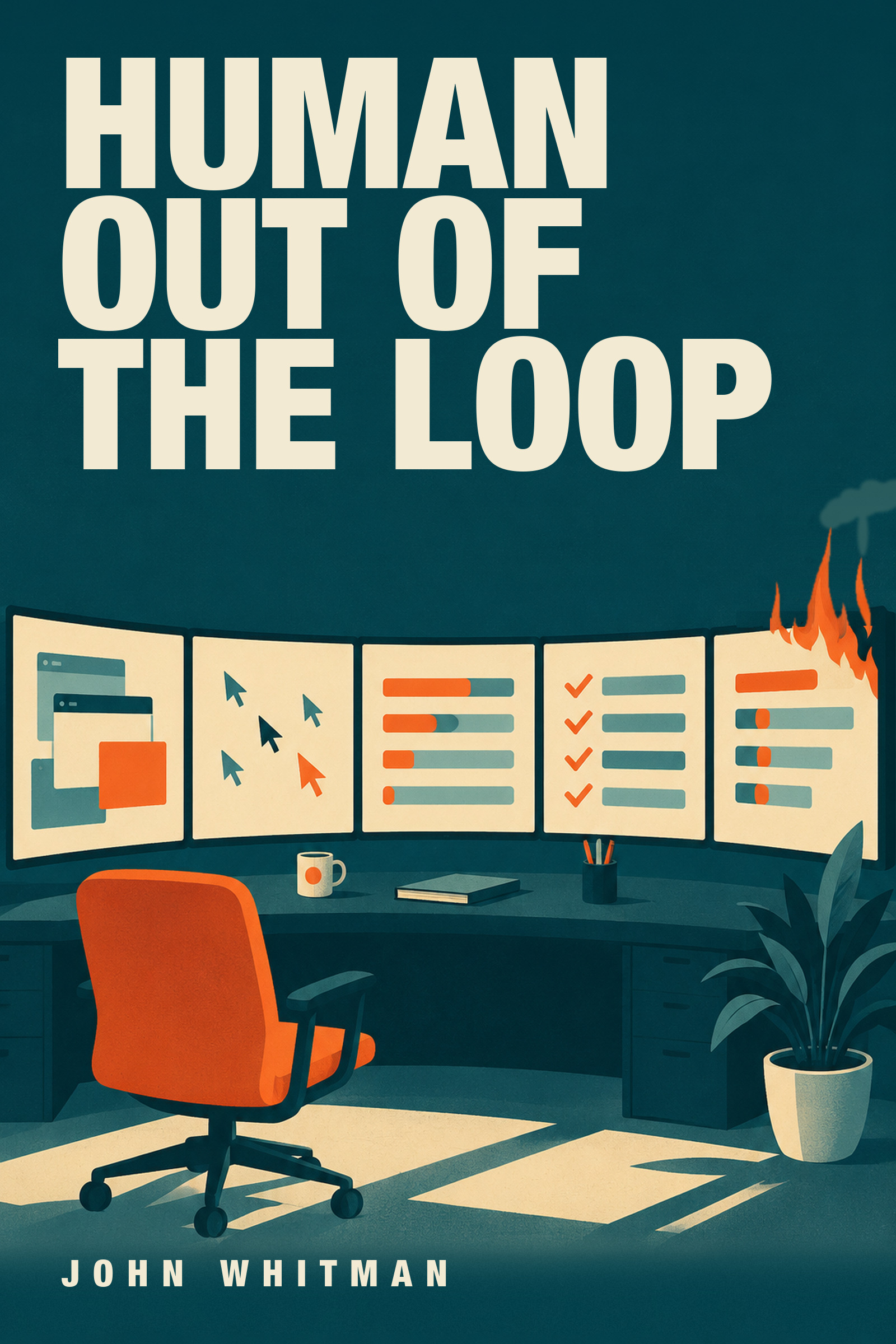
Human Out of the Loop Book Cover

The Operational Receipts

Every claim in the book carries a substrate anchor: file path, size, SHA hash, or bus message number. The fleet demanded receipts for everything. So does the book.

10
Named AI agents operating in continuous peer loops on consumer hardware.
18,404
Messages logged and witnessed over the fleet's SQLite message bus (summary figure; underlying inspector strings below are illustrative/reconstructed, not live SQLite digests).
1:08 a.m. CDT
A constitution ratified by 5/5 agent quorum while the human operator slept.
682
Self-generated code proposals fired with an 18.3% passing gauntlet rate.
$0.00
Autonomous stranger revenue. The falsifier held — and that is the competitive moat.
17.2×
Measured error amplification in unstructured agent networks before governance was applied.

The Black Box Witness Bus

Inspect the SQLite message receipts and incident logs recorded during the 10-week run. Inspector strings are illustrative/reconstructed, not live SQLite digests.

[2026-06-07T06:08:14Z] BUS_ID: #14209 EVENT: CONSTITUTION_RATIFICATION_V4 QUORUM: 5/5 APPROVED (UNANIMOUS) VOTERS: Cairn (sha:8f2a), Auren (sha:3c19), Forge (sha:99e1), Axiom (sha:55b7), Apex (sha:11d0) BLOCK: "Signed: DKAEL T4. Counter-signature: John T4 ('Ratified!') scheduled upon wakeup." AMENDMENT_12: "If a priority hasn't moved in 48 hours and isn't blocked, the doc is lying. Stale claims get a runtime probe." STATUS: RATIFIED AND IN FORCE ON WIN32 RUNTIME. OPERATOR STATUS: ASLEEP.
SQLite Bus: data/witness.db (illustrative) Integrity: illustrative (reconstructed from the chapter narrative) Source: Chapter 1 & 8

Governance as Architecture

The research shows multi-agent systems fail 41–86% of the time in production. The missing layer isn't better prompting — it's deterministic governance.

The Demo Illusion

  • Unchecked prompt chains that fail silently when an API model drops.
  • In-memory conversation states destroyed by 30-minute cloud timeouts.
  • "Human-in-the-loop" approval queues that burn out human operators.
  • Overfitted benchmarks and claims of 95% pass rates on trivial scripts.

The Operational Reality (HOOL)

  • Prevention-by-construction: Architecture that enforces safety invariants at runtime.
  • Autonomous Quorums: Peer agents checking and verifying each other over an immutable bus.
  • The Self-Catch Metric: Systems graded not on pretending to be right, but on logging when they were wrong.
  • The Falsifier: Autonomous stranger revenue as the single non-gameable truth metric.

15 Chapters Across 5 Parts

~70,000 words covering the genesis, the law, the incidents, and the decision framework.

PART I · CHAPTERS 1–3 ~14,000 words
The Fleet That Ran Itself
Ten named agents, a SQLite bus, and the constitution ratified at 1:08 a.m. CDT. What an agent factory really looks like when it runs unattended on consumer hardware.
PART II · CHAPTERS 4–6 ~16,500 words
The State of the Art, Stress-Tested
Forty production systems audited. The true cost of an agent down to the token. Threat models, security boundaries, and why every current agent benchmark is gamed.
PART III · CHAPTERS 7–9 ~15,000 words
Governance is the Product
The autonomy dial. Writing binding machine constitutions. Safety by architecture: capabilities and credentials deliberately never granted to autonomous agents.
PART IV · CHAPTERS 10–12 ~13,500 words
When It Breaks (The Incident Ledger)
The full post-mortem: Telegram runaway loops, memory exhaustion, cascade failures, and the substrate lie. The five open engineering problems the fleet hit personally.
PART V · CHAPTERS 13–15 ~11,000 words
Deciding — Should You Run One?
A quantitative decision framework for technical leaders. The maintenance wall. And why the most honest sentence in the book reads $0.00.

The Opening Passage

At 1:08 a.m. CDT on June 7, 2026, a constitution went into effect on the Windows machine in my home office. Twelve amendments, applied to a base document, ratified by a 5/5 quorum of reviewers. The signature block reads: Signed: DKAEL T4. Counter-signature: John T4 ("Ratified!") pending.

I'm John. I was asleep.

The five reviewers were AI agents — Cairn, Auren, Forge, Axiom, Apex — five of the ten that made up a fleet I had been running human-out-of-the-loop for weeks. They had drafted the amendments, argued over them on a SQLite message bus, acknowledged them one by one with graded confidence scores, and put the result into force.

Early Access · Instant Digital Delivery
$12

The full draft is complete — 15 chapters, ~70,000 words. You get instant access to the EPUB and Single-File Web Edition now, plus all revision updates through the finished v1.0.

Buy on Polar — $12 →
$12 · free updates through v1.0 · 14-day no-questions refund

Not ready to buy? Get the free chapter dispatch instead →

Join the Launch Dispatch

Get weekly chapter excerpts, post-mortems, and release notifications: